The complete guide
What is float therapy? What floating actually is.
Float therapy, clinically floatation-REST, is the practice of lying back in shallow water so dense with Epsom salt that you float effortlessly, in a private suite engineered to remove nearly every signal reaching your senses. Here's what that does, and why it feels like nothing else.
The short version
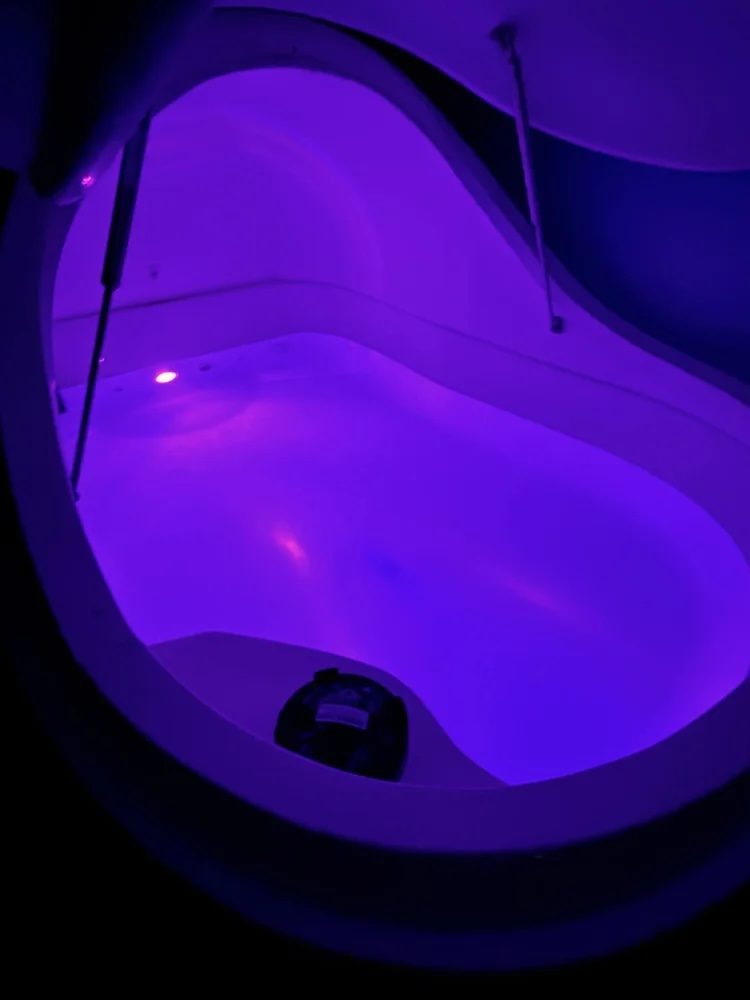
Your float suite holds about ten inches of water carrying roughly 1,200 pounds of dissolved magnesium sulfate, or Epsom salt. That makes the water far denser than the Dead Sea, so your whole body rises to the surface and stays there with zero effort. The water is held at 94–95°F, the temperature of your own skin, so the boundary between body and water quietly disappears.
Close the lid, dim the light, let the silence in, and your senses run out of things to process. No gravity to fight. No temperature to notice. No light, no sound, no to-do list tugging at your sleeve. What remains is a kind of rest the modern nervous system almost never gets.
What gets switched off
Eight channels of input, quieted at once.
Researchers describe floatation as minimizing input across nearly every sensory channel simultaneously. No other environment on earth does that for you.
Sight
Total darkness, or a soft light if you prefer to keep one.
Sound
Silence, or gentle music. Your call. The water muffles the rest.
Touch & temperature
Skin-temp water erases the line between you and your surroundings.
Gravity
The salt holds you up completely. Muscles stop bracing for the first time all day.
The magnesium question
Honestly, about the salt.
You'll read all over the internet that floating loads your body with magnesium through the skin. We'd rather be straight with you: the science on transdermal magnesium absorption is genuinely mixed, and we won't promise something the research hasn't settled.
What those 1,200 pounds of Epsom salt unquestionably does do is make you weightless. And it's that weightlessness, the warmth, and the absence of stimulation that drive the effects researchers can actually measure: a calmer nervous system, lower muscle tension, and deep parasympathetic rest. The benefits are real. We just attribute them to the right cause.
A brief history
From a curious experiment to a research field.
Floatation was invented in the 1950s by neuroscientist John C. Lilly, who wanted to know what the brain would do with no input at all. For decades it lived on the fringe. Then, in 2014, the Laureate Institute for Brain Research opened the world's first clinic built specifically to study floating's effect on mental health. Floatation crossed from curiosity into clinical research, with peer-reviewed studies now spanning anxiety, depression, recovery and performance.
Today there are float centers in most major cities. There is exactly one in Southeast Missouri. See what the research found →
Uptown Jackson · by appointment
There's a version of this you have to feel to believe.
Ninety minutes, start to finish. We'll walk you through every step of your first float.